
Understand before defining
Consider the use case, site, available information, known constraints and stakeholders before defining the involvement.
About
Built around the interfaces of a project.
MAJ Solutions was built around a simple observation: in industrial and regulated projects, difficulties often emerge between disciplines. A project decision, technical choice, field constraint or documentation requirement can lose coherence when each is handled separately.
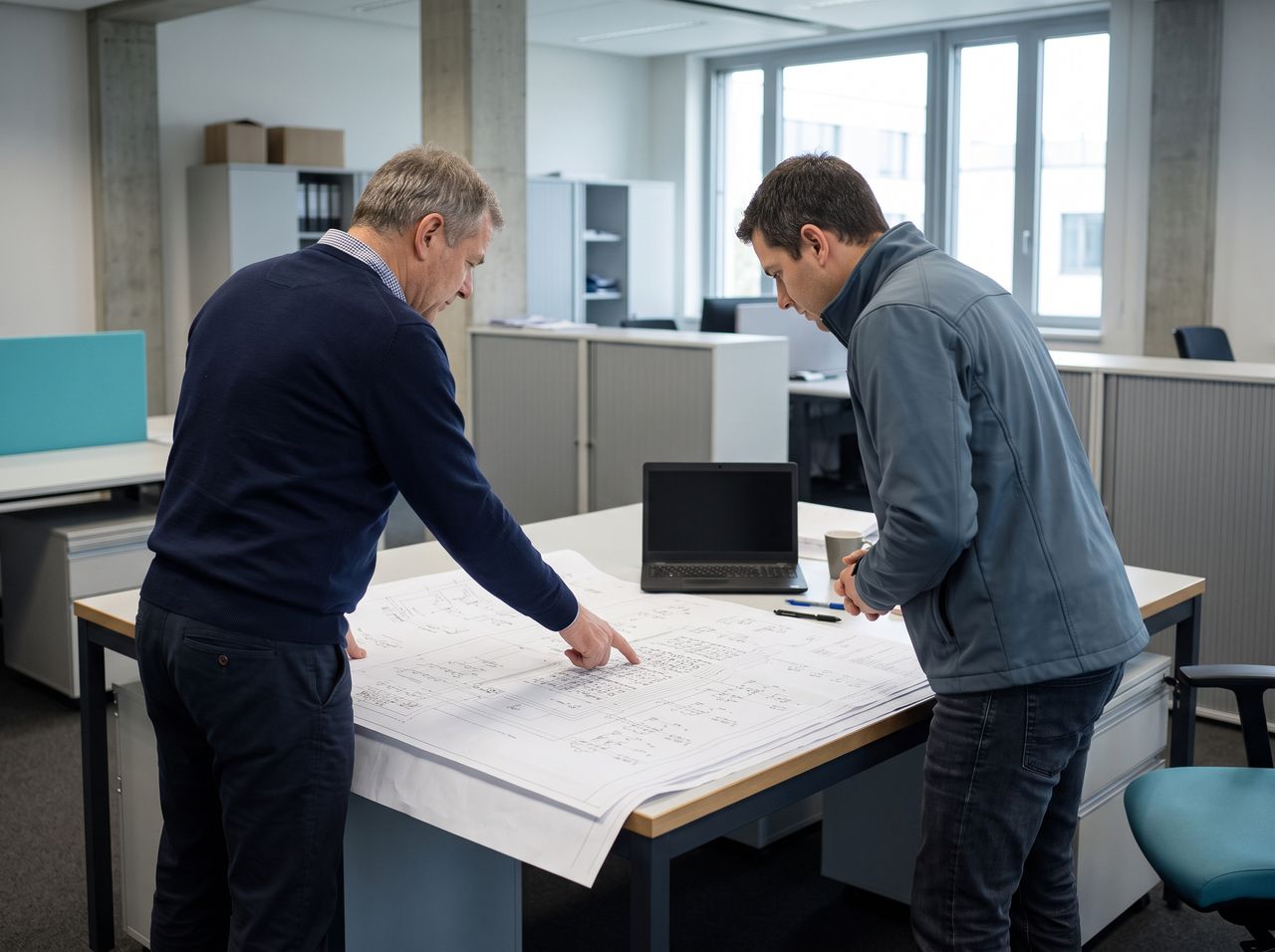
Three challenges recur in critical environments, whatever the site and the size of the project. They are not dealt with separately: it is their combination that makes a project hard.
We bring the relevant disciplines together around a clear scope. Depending on the assignment, that continuity may connect governance, technical design, integration, field execution, testing, commissioning, qualification, validation or start-up preparation.
We are a compact, multidisciplinary Belgian technical team. We bring together the responsibilities relevant to a defined context and scope.
The disciplines involved depend on the actual need and the agreed scope.
Consider the use case, site, available information, known constraints and stakeholders before defining the involvement.
Clarify our role, responsibilities, interfaces and the deliverables included in the assignment.
Make deviations, dependencies or missing information visible when they may affect a decision, implementation, test or commissioning activity.
Prevent engineering, integration, field work, verification and documentation from being treated as isolated subjects when their coordination is part of the need.
Our involvement is organised around four complementary functions. They may contribute separately or combine where a project involves several interfaces.
Structure the project’s progress, coordinate stakeholders, make decisions and risks visible, track actions and prepare sensitive stages.
Assess the decisions required for a system to operate and connect its electrical, automation, instrumentation, EMS or ICT interfaces.
Maintain consistency across requirements, risks, functions, traceability, testing and the expected documentation.
Prepare field activities, coordinate operations, verify installations, diagnose deviations and support start-up.
The detail of responsibilities, technologies and frameworks is on the Expertise page.
We may work on a focused question, a defined phase or a scope that draws on several functions. Points to clarify for each assignment may include:
These elements are reviewed as needed, without imposing a set path.
Based in Belgium, we work mainly in Belgium, Luxembourg and France, and can support projects elsewhere in Europe and internationally, depending on their scope. Our experience in pharmaceutical, biopharmaceutical, healthcare, laboratory, food production and controlled environments is a specialisation of the company, without limiting its activity to the pharmaceutical sector.
Case studies illustrate this approach through concrete needs, responsibilities and constraints.
Tell us about the context, current phase and interfaces already identified. An initial discussion will help clarify the questions to address and the relevant scope.
Discuss your project